

Team Building With Live Music Beats Escape Rooms in 2026

Team building with live music works because it puts every employee, from the intern to the VP of Finance, in the position of performer rather than spectator, and that shift in role is what actually builds trust between coworkers. Escape rooms ask a team to solve a puzzle together. Live music asks them to be vulnerable together, and vulnerability is what sticks in people's memory long after the event ends.
Key Takeaways
Team building with live music turns passive attendees into active performers, which creates stronger shared memories than task-based activities like escape rooms or trivia.
Live music and touring generated $18.51 billion in the United States in 2026, and the sector is growing at roughly 9.1% annually, according to AM World Group, a sign that audiences increasingly expect live entertainment over passive alternatives.
Formats range from structured songwriting workshops to fully produced live band karaoke sessions, and the right choice depends on group size, budget, and how much production support your venue can handle.
Texas Live Band Karaoke is Austin's longest-running live band karaoke act, offering a fully insured, production-ready format built specifically for corporate groups, from 50-person department retreats to national sales kickoffs.
The most common mistake companies make is booking a passive concert or a background band instead of an interactive format, missing the entire point of team building entertainment.
Live band karaoke's transition into a full dance band set after the karaoke portion eliminates the "dead zone" that kills momentum at the end of most corporate events.
Every HR leader planning a 2026 offsite has heard the same complaint: employees are tired of trust falls, tired of escape rooms, and tired of standing around a happy hour bar making small talk with people they already sit next to every day. The activities feel like obligations, not experiences. That fatigue is exactly why more companies across Austin, Houston, Dallas, and San Antonio are shifting budgets toward live music formats that ask people to participate instead of just attend.
At Texas Live Band Karaoke, we've produced shows for Fortune 500 companies, university programs, and national brand activations throughout Texas, and the pattern we see over and over is simple: teams remember the night someone from accounting grabbed the mic and the whole room lost it. They don't remember the escape room they finished in 42 minutes. This guide breaks down why live music outperforms the standard team building menu, what formats exist, and how to choose the right one for your group size and budget in 2026.
You'll walk away from this article knowing the psychological reason live music works better than task-based activities, a full comparison of formats, and a practical framework for planning your own event, whether that's a 30-person department retreat or a 500-person conference night.
What Is Team Building With Live Music?
Team building with live music is a category of corporate entertainment that uses live performance, singing, or instrument-based activities to create shared, participatory experiences among coworkers, rather than passive listening or task-completion exercises. Specifically, it includes formats like live band karaoke, guided songwriting sessions, rock choir experiences, and instrument-based workshops where teams learn and perform together.
Unlike a concert or a background band hired for ambiance, team building with live music requires active participation from attendees. As a result, the format produces a different kind of group memory: one built on shared risk-taking rather than shared observation. Industry programs such as Face The Music and Swallow Hill Music's Band Together have used this model since the late 1970s and late 1990s respectively, proving the concept isn't new; it's simply gaining renewed traction in 2026 as companies look for entertainment that generates genuine engagement instead of a checked box on the culture calendar.
Formats typically run anywhere from a one-hour session to a full evening, and group sizes scale from small teams of 10 to large conference audiences well over 500. The common thread across every format is the same: someone who normally sits behind a laptop all day steps up, takes a risk in front of colleagues, and the room responds. That response, more than any trust fall or scavenger hunt, is what actually builds cohesion.

What Is a Good Song for Team Building?
A good song for team building is one with broad generational recognition, a singable melody, and a build that rewards crowd energy, think anthems like "Don't Stop Believin'," "Livin' on a Prayer," or "I Wanna Dance with Somebody" rather than obscure or vocally demanding tracks. The goal isn't vocal difficulty. It's collective recognizability.
Specifically, songs that work best share three traits: a chorus everyone already knows without looking at lyrics, a tempo that supports movement and dancing, and a structure that builds toward a big, shared moment rather than staying flat throughout. Sales teams and younger workforces tend to respond well to 2000s pop and hip hop crossover hits, while mixed-generation corporate crowds consistently rally around classic rock and 1980s power ballads.
Additionally, song selection matters more at scale. For a 20-person team dinner, a wider range of picks works because the room is intimate. For a 300-person conference night, you need songs that translate across a large room with people who may not know each other. A well-run live band karaoke show, like the format Texas Live Band Karaoke runs across Austin and statewide Texas events, curates a song catalog specifically for corporate crowds, balancing crowd-pleasers with enough variety that the night doesn't feel repetitive by the third hour.
Corporate Rock Stars Team Building with Live Music
What Are Some Fun Team Building Activities Beyond the Usual Options?
Fun team building activities that go beyond escape rooms and happy hours include live band karaoke, guided songwriting workshops, rock choir sessions, and instrument-based ensemble challenges, each of which asks employees to create or perform something together rather than simply complete a task. These formats consistently produce stronger post-event conversation than passive alternatives because they involve visible, shared vulnerability.
For example, songwriting-focused programs structure the experience around collaborative lyric creation: participants pitch ideas, the group shapes them into a song, and a live band performs the finished product on the spot. Other formats, like rock choir experiences, use vocal coaches to guide a group through learning and performing a song together, often marketed around confidence-building and stress relief.
Activity Format | Typical Duration | Best Group Size | Primary Benefit |
Live band karaoke | 2 to 4 hours | 50 to 2,000+ | Maximum participation, minimal prep required from attendees |
Guided songwriting workshop | 1 hour | 15 to 100 | Collaborative creativity, strong storytelling moment |
Rock choir / vocal coaching session | 1 to 2 hours | 10 to 60 | Confidence building, low-pressure entry point |
Instrument ensemble workshop | 2 to 3 hours | 10 to 80 | Mirrors workplace roles and synchronization |
Escape room | 1 hour | 4 to 12 per room | Puzzle-solving, limited crowd energy |
Standard happy hour | 2 to 3 hours | Any size | Low structure, no forced participation |
Notably, instrument-based ensemble programs like Be Challenged's Orchestrate deliberately mirror workplace dynamics, showing how individual contributions synchronize into a collective result. That framing resonates with leadership teams looking to justify the activity's ROI beyond "it was fun."
What Is the 3 Minute Rule in Music, and Why Does It Matter for Corporate Events?
The 3 minute rule in music refers to the traditional radio-era convention that a song's ideal length runs close to three minutes, long enough to build a hook, verse, and chorus, but short enough to hold a listener's attention without dragging. For corporate team building, this rule translates directly into pacing strategy: songs and performance segments need to move fast enough to keep energy high across a room of mixed engagement levels.
In practice, this means a well-run live music format doesn't let any single performer's turn run too long, and it doesn't let momentum sag between songs. A live band karaoke show typically keeps individual performance turns tight, usually one song per singer or small group, so the emcee can maintain pacing and keep the energy climbing rather than plateauing. Additionally, the three-minute convention explains why professional emcees matter: someone has to manage transitions, reset the crowd's attention, and keep the show moving during set changes.
For event planners managing a 300-person conference night, pacing is the single most overlooked production detail. A show that runs too slow loses the room within 20 minutes. This is one reason Texas Live Band Karaoke pairs its live band karaoke format with high-energy emcees specifically trained to manage pacing across a range of audience sizes, rather than leaving that responsibility to whoever happens to be holding the microphone.
What Are Some Fun Music Classroom or Workshop Activities That Translate to Corporate Settings?
Fun music classroom activities that translate well to corporate team building include call-and-response singing exercises, small-group harmony challenges, and collaborative playlist building, all of which were originally developed for educational settings but work equally well for adult teams because they lower the stakes of participation. Corporate adaptations of these classroom techniques give hesitant employees a lower-pressure entry point before a full performance format.
For instance, call-and-response exercises, common in music education, let a group practice singing together in unison before anyone is asked to perform solo. This warm-up step matters more than most planners realize: research from workplace psychology consistently shows that low-stakes group participation builds the confidence needed for higher-stakes participation later in an event.
Similarly, team playlist building, where each department contributes songs to a shared event playlist ahead of time, has become a popular pre-event engagement tool, especially for hybrid and distributed teams who can't be in the same room until event day. Virtual formats like tiny desk-style concerts and virtual karaoke sessions extend this same participatory principle to remote teams, an important consideration in 2026 as more companies run hybrid offsites that blend in-person and remote attendees.
How Does Live Music Team Building Compare to Escape Rooms and Happy Hours?
Live music team building outperforms escape rooms and happy hours because it produces visible, shared vulnerability rather than task completion or unstructured socializing, and that vulnerability is what creates lasting group cohesion. Escape rooms measure success by whether a puzzle gets solved. Happy hours measure success by whether people show up. Live music measures success by whether the room feels different by the end of the night, and it almost always does.
Escape rooms cap out around 4 to 12 people per room, which means a 100-person department has to split into 10 separate groups that never interact with each other during the activity. That fragmentation defeats the purpose of a company-wide team building event. Live band karaoke, by contrast, keeps the entire group in one room, one shared experience, from 50 people to well over 2,000.
Happy hours, meanwhile, offer zero structure. Some employees mingle easily; others stand near the wall checking their phones. There's no forcing function that creates a shared moment. Live music formats build that forcing function directly into the structure: someone has to get up, sing, and the room has to respond. That structure is exactly why event planners increasingly favor corporate event karaoke over an open bar with a playlist running in the background.
Factor | Live Music Team Building | Escape Room | Happy Hour |
Whole-group participation | Yes, scales to 2,000+ | No, splits into small rooms | No structure enforced |
Forces shared vulnerability | Yes | Occasionally | Rarely |
Works for mixed seniority levels | Yes | Yes, in small groups | Yes, but disengagement common |
Post-event conversation generated | High | Moderate | Low to moderate |
Scales to large conferences | Yes | Difficult above 50 people | Yes but low engagement |
Why Does Live Music Affect Team Psychology Differently Than Other Activities?
Live music affects team psychology by lowering social defenses through shared, low-stakes risk-taking, a mechanism that task-based activities like escape rooms rarely trigger because puzzles don't require personal exposure. When a colleague sings in front of the group, even imperfectly, it signals psychological safety: if they can be vulnerable and the room responds with support instead of judgment, everyone else's guard drops a little too.
This is not a new observation. Programs like Engage4More's Corporate Antakshari format frame group singing as an "auditory synchronization" exercise specifically because rhythmic, shared vocal activity has been linked to reduced mental fatigue and smoother communication in group settings. Live music doesn't just entertain; it changes the room's baseline comfort level for the rest of the event, including the more serious sessions the next day.
Based on what we consistently see across our own shows at Texas Live Band Karaoke, the moment that shifts a room isn't the professional band's opening set. It's the first time an unlikely volunteer, someone who swore they'd never sing, takes the mic and the crowd goes with them. That single moment resets the social contract for the rest of the night. No escape room clue or trivia round produces that same effect, because none of them ask a person to be seen the way live singing does.
How Do You Choose the Right Live Music Format for Your Group Size and Goals?
Choosing the right live music format depends primarily on three variables: group size, available budget, and whether the goal is confidence-building versus pure celebration. Specifically, smaller teams of 10 to 60 benefit most from guided formats like songwriting workshops or rock choir sessions, which build in more individual coaching time. Larger groups of 100 to 2,000-plus need a format built for scale, like live band karaoke, which doesn't require every attendee to perform to generate room-wide energy.
Additionally, consider your venue. A songwriting workshop or instrument ensemble needs breakout space and instructor-to-participant ratios that get expensive fast at scale. Live band karaoke needs a stage, sound system, and open floor, infrastructure most hotel ballrooms, conference centers, and event venues already have. This is one reason live band karaoke scales more efficiently for large corporate audiences than smaller, instructor-heavy formats.
For sales kickoffs and annual conferences specifically, prioritize formats with strong pacing and a natural transition into open dancing once the structured portion ends. A show that peaks and then abruptly stops leaves the room flat for the rest of the night. This is exactly why Texas Live Band Karaoke built its format around a seamless transition from the live karaoke set directly into a full high-energy dance band set, so the momentum built during karaoke doesn't die the moment the structured activity ends.
What Does a Fully Produced Live Music Team Building Event Actually Include?
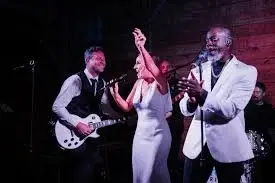
A fully produced live music team building event includes a professional live band, an experienced emcee to manage pacing and crowd energy, HD lyric screens so performers never fumble words, and premium sound and lighting production that makes a hotel ballroom or convention hall feel like a real concert venue. Without these production elements, a "live music" event is really just a karaoke machine with better marketing.
Texas Live Band Karaoke is Austin's longest-running live band karaoke act, and the format we've built over years of shows across Austin, Houston, Dallas, and San Antonio centers on one core differentiator: a consistent, rehearsed lineup of musicians rather than rotating pickup players filled in based on availability. That consistency means the performance quality doesn't fluctuate from one event to the next; you're getting a rehearsed, production-ready show every time, whether it's a 50-person team retreat or a national brand activation.
We're also fully insured, which matters more than most first-time planners realize. Venue coordinators, university risk managers, and Fortune 500 legal teams all require proof of insurance before signing off on entertainment vendors, and a band that can't produce it becomes a logistics headache rather than a solution. After the karaoke portion wraps, the show transitions directly into a high-energy dance band set, extending the entertainment value and keeping the dance floor full instead of leaving a dead zone once the structured activity ends. If you're comparing entertainment formats for an upcoming sales meeting or kickoff, this is the kind of production detail worth asking every vendor about directly.
How Can Small Companies Run a Low-Budget Live Music Team Building Session?
Small companies can run a low-budget live music team building session by starting with a structured, low-production format like a team playlist exercise, a small-group karaoke night using a rented PA system, or a call-and-response singing warm-up before a larger event, none of which require hiring a full professional band or agency. These entry-level formats work well for teams under 30 people with limited event budgets.
For example, a department of 20 can build a shared playlist over two weeks, then host a casual "listen and vote" session during a lunch break, a format that costs almost nothing beyond a speaker and requires no outside vendor at all. Alternatively, renting a basic karaoke machine and running an informal after-hours session in the office common area gives a small team the participatory element of live music without the production budget of a full band show.
That said, the trade-off is real: DIY formats lack the polish, pacing, and crowd energy that a professional emcee and live band bring, and the difference becomes obvious once a group grows past 40 to 50 people. For a small pilot event, DIY works fine. For an annual company-wide event where leadership is watching engagement outcomes, most companies eventually graduate to a professional live band karaoke format precisely because the production quality changes how the whole room responds, not just how good the singers sound.
How Do You Justify the Cost of Live Music Team Building to Leadership?
Justifying the cost of live music team building to leadership comes down to framing the investment around measurable engagement outcomes rather than treating it as a discretionary perk. Specifically, tie the request to retention and culture metrics your company already tracks: post-event employee surveys, participation rates compared to prior team building activities, and qualitative feedback gathered in the weeks following the event.
First, compare the per-head cost of live music entertainment against the per-head cost of alternatives like an escape room circuit, which requires splitting a large team into multiple paid sessions, or a catered happy hour with no structured activity at all. When you account for the fact that live band karaoke keeps an entire department in one room for one price, the per-head economics often compare favorably, particularly at scale.
Additionally, frame the request around what finance teams actually care about: reduced turnover risk and stronger internal referrals, both of which correlate with how employees describe their company culture externally. A memorable, well-produced entertainment moment becomes something employees talk about in interviews they give for other jobs, referral conversations, and LinkedIn posts, unpaid marketing that a forgettable happy hour never generates. Reference how the format worked for teams your company has already exposed to interactive corporate entertainment, and you have a concrete internal case study to point to.
Practical Guidance: How to Plan and Avoid Common Mistakes
Planning a successful live music team building event requires attention to a handful of logistics that consistently trip up first-time organizers. Below is a practical framework based on patterns we see across corporate bookings throughout Texas.
Book 6 to 10 weeks ahead during peak seasons. Fall corporate event season and December holiday parties compress vendor availability across Austin, Houston, Dallas, and San Antonio. Waiting until the last month often limits your options to whoever happens to be free.
Confirm insurance and production requirements with your venue first. Hotel ballrooms, university venues, and convention centers often have specific insurance minimums and sound restrictions. Ask any vendor for proof of insurance before signing.
Match the format to your group size, not your budget alone. A songwriting workshop that works beautifully for 25 people falls apart logistically at 300. Scale the format to the room, then adjust the budget.
Don't let the entertainment end before the night does. A structured activity that wraps with an hour left on the venue clock creates an awkward, low-energy tail end. Formats with a built-in transition, like live karaoke moving into a dance band set, solve this automatically.
Pick songs for the room, not for yourself. The event planner's favorite deep cut rarely lands the same way a universally known anthem does. Trust a professional song curation process built for mixed-age corporate crowds.
Assign a single point of contact for day-of logistics. Load-in times, green room needs, and sound checks go smoother when one person owns coordination instead of splitting it across departments.
Common mistakes worth avoiding: hiring a background band that only plays covers without inviting participation (this produces a concert, not team building), skipping the emcee role entirely (pacing collapses without someone managing transitions), and underestimating how much production quality affects participation rates. A thin, laptop-based karaoke setup with no live instrumentation rarely generates the same crowd energy as a full band with premium sound and HD lyric screens.
Frequently Asked Questions
What is a good song for team building?
Widely recognized anthems with singable choruses work best, songs like "Don't Stop Believin'," "I Wanna Dance with Somebody," or "Livin' on a Prayer." The key is broad generational recognition and a tempo that supports movement, not vocal difficulty.
What is the 3 minute rule in music?
The 3 minute rule refers to the traditional convention that songs run close to three minutes to hold listener attention while still building a full verse-chorus structure. For corporate events, this translates into pacing: keeping performance turns tight so the emcee can maintain crowd energy throughout the show.
How far in advance should I book live music team building entertainment in Texas?
Book 6 to 10 weeks ahead, especially during fall corporate event season and December holiday party season in Austin, Houston, Dallas, and San Antonio, when vendor calendars fill quickly. Earlier booking also gives you more flexibility on song curation and production customization.
Does live band karaoke work for a conference of 500 or more people?
Yes. Live band karaoke scales well for large audiences because the format doesn't require every attendee to perform individually to generate room-wide energy. Texas Live Band Karaoke has produced shows for large-scale conferences and national brand activations where production readiness and insurance compliance matter as much as entertainment value.
What happens after the live karaoke portion of the show ends?
A well-produced show transitions directly into a high-energy dance band set rather than ending abruptly. This eliminates the "dead zone" that occurs when structured entertainment wraps up before the venue closes, keeping the dance floor active for the rest of the night.
Is live music team building appropriate for a university campus event with institutional requirements?
Yes, provided the vendor is fully insured and experienced with institutional policies around sound levels and venue logistics. Live band karaoke works well for orientation events, homecoming celebrations, and Greek life programming because it's crowd-pleasing without requiring extensive setup outside standard campus AV capabilities.
How is live band karaoke different from a regular karaoke machine or app-based karaoke?
A live band karaoke show uses a rehearsed professional band, real instrumentation, and full production including HD lyric screens and premium sound and lighting, rather than pre-recorded backing tracks played through a laptop. The difference in crowd energy is significant: a real band responds to the room in real time, while a track just plays the same way regardless of who's singing.
Can small companies run live music team building without hiring a full band or agency?
Yes, for smaller teams under 30 people, low-budget options like a shared team playlist exercise or a rented basic karaoke setup can work. The trade-off is reduced production quality and crowd energy, which becomes more noticeable as group size grows past 40 to 50 attendees.
Conclusion: Choosing Live Music for Your Next Team Building Event
Team building with live music consistently outperforms escape rooms and happy hours because it replaces passive participation or unstructured socializing with shared, visible risk-taking, the exact mechanism that builds trust between coworkers. With the U.S. live entertainment sector growing at roughly 9.1% annually as of 2026 according to AM World Group, employee expectations for genuine, interactive entertainment are only rising heading into 2026.
Whether you're planning a 30-person department retreat or a 2,000-person conference night, the format matters more than the budget line item. Texas Live Band Karaoke has spent years building a production-ready, fully insured live band karaoke show specifically for corporate audiences across Austin, Houston, Dallas, and San Antonio, and the pattern holds every time: the room remembers the person who took the mic, not the puzzle they solved in a locked room. As more companies move away from generic team building menus in 2026, live music formats built around real participation are becoming the standard, not the novelty.

If you're planning a corporate event in Austin or anywhere across Texas and want entertainment your team will actually talk about the following Monday, Texas Live Band Karaoke would love to be part of it. Request a quote and let's build the team building experience your event deserves.
Written by Greg Williams, Owner & Band Leader at Texas Live Band Karaoke
Content powered by inkSTR.co


Comments